Synopsis
Artificial intelligence is reshaping eye care, but not without challenges. This month’s feature, Bias in the Eye of the Algorithm, explores how training data, model design, and deployment can unintentionally introduce diagnostic bias in ophthalmic AI. The article highlights why fairness, transparency, and inclusive datasets are essential to ensure AI benefits every patient — not just those reflected in early research. A must-read for anyone interested in ethical and equitable vision technology
Introduction
Artificial intelligence (AI) has rapidly become a powerful tool in ophthalmology, supporting the detection and management of conditions such as diabetic retinopathy, glaucoma, cataracts, and age-related macular degeneration. While these systems show remarkable accuracy and promise, a growing concern remains at the forefront: algorithmic bias. If not acknowledged and addressed, bias embedded within AI models risks reinforcing inequalities in eye care and misdiagnosing patients from under-represented groups.
Where Does Bias Begin?
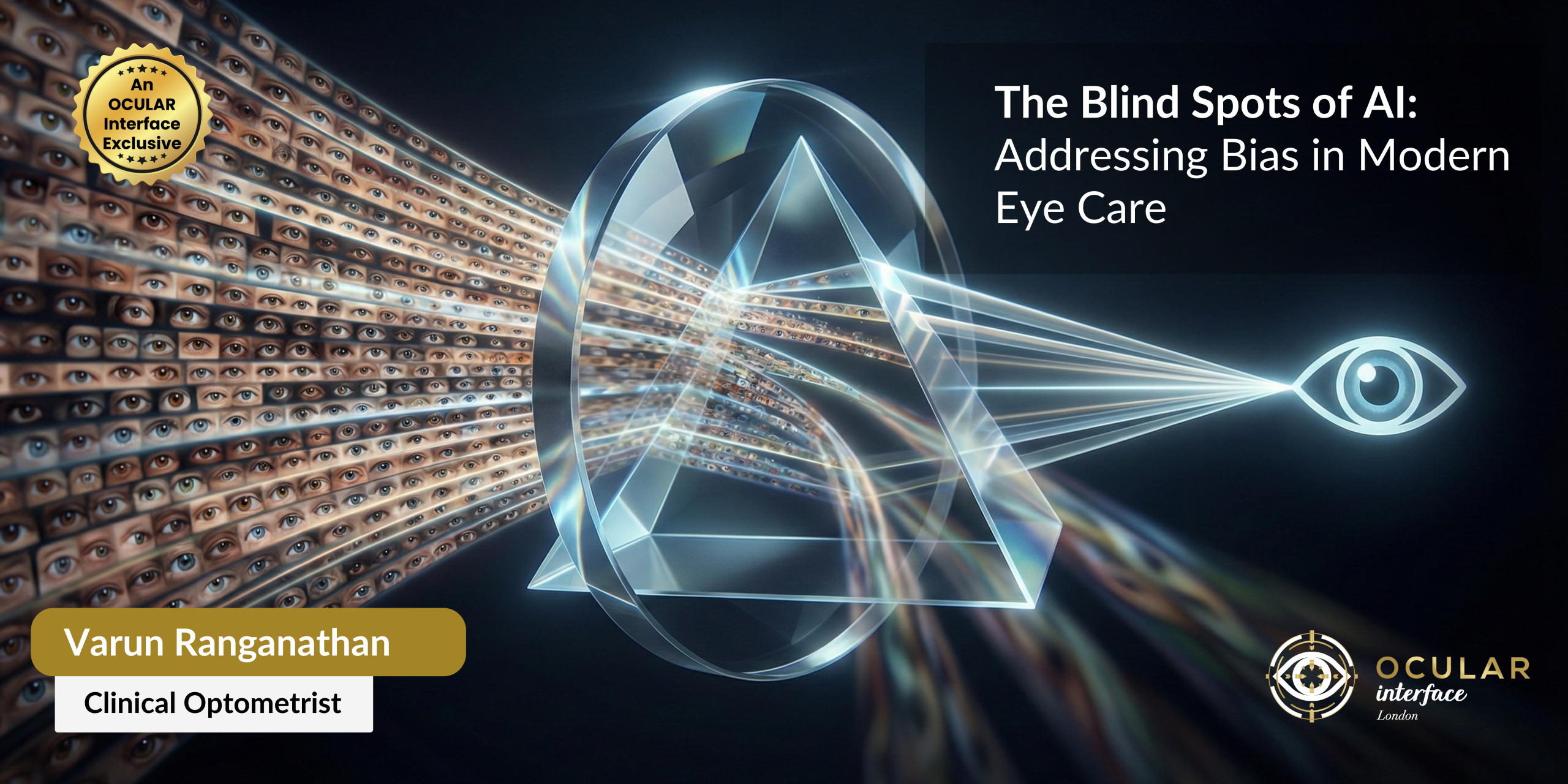
Bias in ophthalmic AI typically originates from the data used to train machine-learning models. Many models are built using datasets collected from specific populations — often skewed toward certain ethnicities, age groups, or socioeconomic backgrounds — rather than reflecting global diversity. When an AI model trained primarily on one patient, demographic is applied to another, diagnostic performance can decline significantly. 1,2
A widely cited study demonstrated that some commercial ophthalmic AI tools performed less accurately in detecting diabetic retinopathy in Black and Asian patient groups compared with white patients, due to limited representation in training datasets. 3 This gap highlights the ethical responsibility to ensure datasets are representative and inclusive.
The “Black Box” Challenge
Another issue is model opacity. Deep-learning systems often operate as “black boxes”, making predictions without revealing how decisions were formed. 4 When a clinician cannot fully understand or explain how an algorithm reaches a diagnosis, trust becomes fragile — particularly if inconsistent performance occurs across demographic lines.
Efforts to increase explainability, such as heatmaps, confidence scoring, and interpretable model architectures, are essential to ensuring transparency and clinician confidence.5
The Impact on Patient Care
If unaddressed, bias can translate into unequal access to accurate diagnosis and treatment. For example, patients with darker fundus pigmentation — common among African and South Asian populations — may receive less accurate retinal disease assessments from AI models trained primarily on lighter retinal images. 6,7 In global health contexts, this could exacerbate disparities rather than close them.
Building Fairer Algorithms
Solutions require action on multiple fronts:
- Diverse and global datasets: Models must be trained using data representing varied ethnic groups, age ranges, and clinical presentations. 8
- Continuous auditing: AI should undergo post-deployment evaluation to detect performance drift or emerging bias. 9
- Regulation and collaboration: Developers, clinicians, and regulators must work together to establish standards for equity, transparency, and ethical deployment. 1
Encouragingly, several international initiatives now focus on equitable AI development in ophthalmology, including federated learning networks that allow global data collaboration without compromising privacy.
Conclusion
Ophthalmic AI holds enormous potential to transform eye care and prevent avoidable blindness. However, this potential depends on fairness, accountability, and equitable design. Recognising bias is the first step — correcting it is the real challenge.
As the field advances, building AI systems that serve all eyes fairly will be key to shaping a future where technology truly supports universal vision health.
References
- Ting DSJ et al. “Artificial intelligence and deep learning in ophthalmology.” Br J Ophthalmol. 2019.
- De Fauw J. et al. “Clinically applicable deep learning for diagnosis and referral in retinal disease.” Nat Med. 2018.
- Redd T. K. et al. “Evaluation of bias in commercial retinal disease detection algorithms.” JAMA Ophthalmology. 2021.
- Rudin C. “Stop explaining black box machine learning models.” Nature Machine Intelligence. 2019.
- Holzinger A. et al. “Explainable AI for medicine.” WIREs Data Mining Knowledge Discovery. 2021.
- Daneshvar R. et al. “Fundus pigmentation and its effect on AI model performance.” Ophthalmology Retina. 2023.
- Haenssle HA. “Ethnic variability in deep learning diagnostic accuracy.” Lancet Digital Health. 2022.
- Xu X. et al. “Federated learning in ophthalmology.” npj Digital Medicine. 2022.
- UK MHRA. Software and AI as a Medical Device Change Programme. 2022.
- WHO. Ethics and Governance of AI for Health. 2021.